The NDC Brand Promise: Mahama, Dogbe, Gyamfi, and the Art of Political Brand Transformation
This piece is still being written.
A full analysis of the NDC brand transformation — the strategy, the people, and what it means for political branding in Ghana. Subscribe to be notified when it publishes.
← Back to PerspectivesTo understand what Mahama did to the NDC, you have to understand what the NDC was before him. The National Democratic Congress was founded by Jerry Rawlings, who had been Ghana's military leader since 1981. In 1992, the party led the transition to multi-party competition — an example of authoritarian-led democratisation. Its origin was not in democratic activism. It was born from the barrel of a gun, and for years it wore that identity like a second skin.
The Rawlings Inheritance: What Mahama Walked Into
This mattered enormously to how Ghanaians perceived the party. The NDC's base was built on the Rawlings-era redistribution story — a working-class, populist, anti-elite movement with deep roots in the Volta Region, the Northern corridor, and rural Ghana. It was a party of loyalty first and policy second. It had an ideological heartbeat rooted in Rawlings' June 4th rhetoric, but it had never been a modern, messaging-disciplined, brand-coherent political organisation. It was a movement that had institutionalised itself, not a brand that had earned itself.
John Dramani Mahama served as a Member of Parliament for Bole/Bamboi from 1997 to 2009, as Deputy Minister for Communications between 1997 and 1998, and became the substantive Minister for Communications in 1998. In 2002, he was appointed the Director of Communications for the NDC. That last point is critical and often overlooked. Before Mahama was a presidential candidate, he was the party's communications architect. He understood, from the inside, exactly what the NDC's messaging weaknesses were. He had seen, from the communications seat, how the party talked past its own voters. He knew the gap between what the NDC believed it stood for and what ordinary Ghanaians actually received.
That background — communications director, then vice president, then president — is the foundation of everything that followed.
The 2016 Defeat and What It Revealed
The 2016 loss was the sharpest mirror the NDC had ever been forced to look into. Research into the defeat identified a breakdown of internal party structures, ineffectiveness of the party's campaign message, irresponsible behaviour by some government appointees, lack of coordination of campaign activities, and — most damningly — the failure of the party to distinguish between positive macro-economic indicators and the general standard of living. The party had stopped listening to popular sentiments about economic hardship.
That last point is everything. The NDC in 2016 was telling people that the economy was fine — citing IMF and Moody's ratings — while people could not buy food or pay school fees. This was not just a policy failure. It was a catastrophic communications failure. The party had become arrogant in power and tin-eared in messaging. It was speaking the language of technocrats to a population asking for the language of dignity.
The NDC in 2016 was telling people that the economy was fine — while people could not buy food or pay school fees. That is not a policy failure. That is a communications failure.
This made Mahama the first president in the history of Ghana not to have won a consecutive second term. The humiliation of that distinction forced a reckoning that became the soil from which the 2024 comeback grew.
The Opposition Years as Brand Workshop
What happened between 2017 and 2024 is the real story. Most parties in opposition either collapse inward with infighting or coast on hope that the ruling side will implode. Mahama and the NDC did something more deliberate. They went back to the people.
In August 2021, Mahama began a tour dubbed the "Thank You Tour," visiting the Upper West, Upper East, North East, Northern, and Savannah Regions in the first phase, meeting chiefs, queens, religious leaders, and interacting with the media. This was not a political rally. It was a listening exercise dressed in humility. The symbolism was intentional: a former president going back to the people — not with promises, but with gratitude. It reframed defeat as dignity. It said: we hear you.
The party simultaneously invested in its communications infrastructure. The NDC held a three-day workshop for all Regional Communication Officers, deputy regional officers, the Social Media Team leadership, and members of the National Communications Team, under the theme "Purposeful Communication for Victory 2024." This was professional-grade communications training rolled out at a grassroots level — the kind of work that does not make headlines but wins elections precinct by precinct.
The running mate selection in 2020 had signalled something. Choosing Professor Jane Naana Opoku-Agyemang — a former Education Minister, academician, and the first female Vice-Chancellor of the University of Cape Coast — was a statement of intent. It said: this is a party that takes intellect, women, and institutions seriously. Even though the 2020 election was lost narrowly, the brand signal was planted. The same running mate deployed as a brand signal in 2020 became Ghana's historic first female Vice-President in 2025. The strategy was consistent across campaigns.
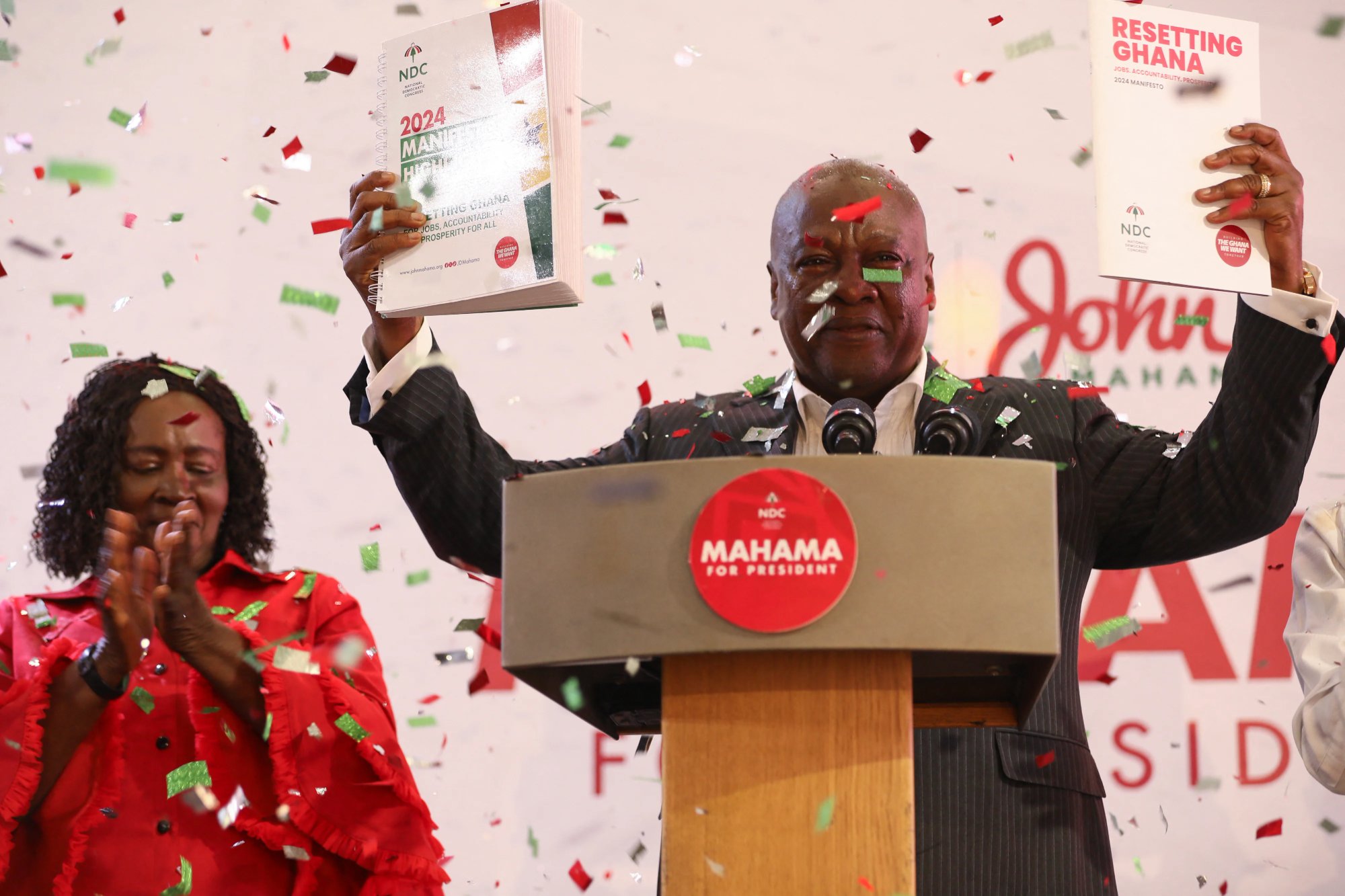
"Resetting Ghana" — The Manifesto as Brand Document
By 2024, the NDC had developed something it had never had before: a clear, single-word brand narrative. Reset. The campaign's theme, "Changing to Reset," reflected the party's commitment to revitalising Ghana's political and economic landscape.
This was not just a political slogan. It was the cleanest possible answer to the NDC's own history. The word "reset" acknowledged — without apologising — that things had gone wrong. It did not say we were always right. It said: things are broken, and we have the credibility and the will to start again. It spoke to voters who had suffered under eight years of governance that had not delivered on its promises, while also acknowledging that the NDC's last term had not been perfect. It was an invitation, not a boast.
Mahama's campaign positioned him as a reformist advocating economic recovery and educational reform, using structured engagement and clear thematic consistency across platforms. He frequently framed Ghana's economic challenges around the policy slogan "1 Job, 3 Shifts, 3 People" — deploying the 24-hour economy as a transformative, memorable, visual idea.
Stan Dogbe — The Engine Behind the Signal
No account of the NDC's communications transformation is complete without Stan Dogbe. He is a journalist with over 25 years of practical experience — a communications specialist and consultant, a political and campaign strategist, a digital media enthusiast, and an entrepreneur. He has worked with President Mahama as his Special Assistant and Director of Communications since 2012. Before that, he served as a Presidential Aide to the late President John Evans Atta Mills and then to Vice President Mahama.
His background matters. Before politics, Dogbe worked at Joy FM, one of Ghana's most prominent radio stations, where he was the mastermind behind the influential Super Morning Show — a programme that became a cornerstone of public discourse in the country. He did not come from a backroom academic tradition or a party machinery tradition. He came from journalism: the real, competitive, ratings-measured world of making complex things legible to mass audiences every morning at 6 a.m.
He brought that sensibility into the presidency and into the campaigns. Responsible for all backend communications and campaign operations for both the 2020 and 2024 campaigns, Dogbe managed communications, digital campaigns, and operations. He also founded WoezorTV — a television platform that played a crucial role in branding Mahama's image on social media and in the broader media space. This was not passive media relations. This was building your own distribution infrastructure — owning a channel, not just pitching stories to others.
His loyalty through the wilderness years mattered symbolically. Even during the challenging years following the 2016 defeat, Dogbe remained a steadfast supporter — a loyalty rooted not merely in political allegiance but in a deep personal bond and a shared vision for Ghana's future. In January 2025, he was appointed Deputy Chief of Staff in charge of Operations, continuing to shape the President's communication strategy.
It is worth noting that Dogbe has also been controversial. Critics argued that his concentration of influence — handling the President's travels, communications, schedules, protocols, security, and political strategy — posed a governance risk. That tension between the value of a disciplined communications principal and the danger of over-centralising around a single loyalist mirrors exactly what happened with Alastair Campbell in Downing Street.
Blair and Campbell — The Original Template
The NDC's communications evolution between 2016 and 2024 carries remarkable structural parallels to what Tony Blair and Alastair Campbell did to the British Labour Party between 1987 and 1997. Labour in 1987 was a party that had become associated with one era, one set of symbols, one kind of voter — and had lost the ability to speak to the country it wanted to govern. Having just lost a third successive general election, the party's constitution, its language, its brand identity — everything was sending signals that repelled swing voters.
Blair's solution was radical. The phrase "New Labour" appeared at the party's annual conference a mere three months after he became leader. His early moves were often more symbolic than substantive — because symbolism first, substance second is counterintuitive to policy people but it is the truth of political branding. Voters do not read manifestos. They receive feelings. The word "New" in New Labour did more political work than any policy document Blair ever published.
Symbolism first. Substance second. This sequencing is counterintuitive to policy people but it is the truth of political branding. Voters do not read manifestos. They receive feelings.
Campbell left the Today newspaper to become Blair's press secretary shortly after the 1994 leadership election. In addition to being press spokesman, he was Blair's speechwriter and chief strategist, earning a reputation for ruthless news management. The key word is ruthless. Campbell brought to Blair's operation what Dogbe brought to Mahama's: a journalist's understanding that the story you tell is as important as the policy you make, and a strategist's willingness to enforce message discipline across every voice in the party.
During the run-up to the 1997 election, Philip Gould conducted one focus group a week in the three years before polling day; during the campaign itself he ran six a week. The information gathered was restricted to a small circle of MPs and advisers around Blair — underlining the centralised nature of the New Labour project. Both operations functioned by centralising communications into a small, trusted, fast-moving core rather than distributing it through a large, slow committee.
The Key Structural Similarities — and the Critical Differences
What Mahama-NDC and Blair-New Labour share is substantial. Both operations understood that a defeated party must do more than wait. Labour lost in 1983, 1987, and 1992 before winning in 1997. The NDC lost in 2016 and 2020 before winning in 2024. In both cases, the rebuild was not accidental — it was strategic, painful, and involved confronting the party's own failures honestly. Both found a single, powerful narrative frame: "New Labour" and "Resetting Ghana" are functionally the same kind of word-work, forward-facing without being naïve. Both invested in communications infrastructure — not just spokespeople, but the entire pipeline from research to message to delivery. And both paired an experienced politician with a media-trained communications principal who had spent their career making things legible to mass audiences.
Where they differ meaningfully: Blair's project was ideologically transformative in a way that the NDC's was not. Blair announced the modification of Clause IV, abandoning Labour's attachment to nationalisation and embracing market economics. He argued that parties which do not change die. This was structural doctrinal change — Labour publicly killing a part of its own belief system to prove it had moved on.
Mahama did not do this. The NDC's rebranding was more tonal than doctrinal. The party did not publicly repudiate its Rawlings-era heritage. It softened it, contextualised it, and built a new language on top of it. "Resetting Ghana" is a gentler move than "New Labour" — it does not ask the party to disown itself, only to redirect itself.
Blair also had the advantage of a two-party system and a media environment he could shape directly. Campbell's ability to court Murdoch's newspapers — winning The Sun's endorsement in 1997 — was a decisive, singular move. Mahama operated in a more dispersed media environment, which is why Dogbe's investment in owned media — WoezorTV, digital campaign infrastructure — was so strategically important. In the Ghanaian context, you cannot win The Sun's endorsement. You have to build your own Sun.
Sammy Gyamfi — The Attack Dog Who Became the Architecture
If Stan Dogbe was the strategist behind the curtain — the operational spine — then Sammy Gyamfi was the face on the battlefield, the daily voice that kept the NDC brand alive, aggressive, and relevant through the most gruelling years of opposition. Dogbe commanded the communications infrastructure; Gyamfi commanded public combat.
Sammy Adu Gyamfi is a Ghanaian lawyer and politician. In 2018, he contested for National Communications Officer during the NDC National Executive Elections and won by beating his only contender by 4,000 votes — receiving 6,225 out of 9,000 votes cast. He was 29 years old. In a party with a culture of seniority and grey hair, that was a statement in itself.
His involvement in TEIN at KNUST led him to cross paths with influential NDC leaders, including Kofi Totobi Quakyi, who became his mentor. Notably, Gyamfi had initially joined TESCON, the tertiary education wing of the then-ruling party, before finding his place in NDC-affiliated TEIN — drawn by its diversity and inclusivity. That origin story matters. Gyamfi was not born NDC. He was converted NDC — which makes him a persuader by nature, not merely a loyalist. He knew what it felt like to choose the party. He would spend his career making others feel that same pull.
What Gyamfi brought to the NDC brand was relentlessness. In an eight-year opposition stretch, the temptation for a party's communications function is to become reactive and tired — responding to government statements rather than setting the agenda. Gyamfi refused that posture. For him and his associates, there were no compromises to be made ahead of 2024. The crucial distinction between Gyamfi and older members of the NDC establishment is that they carried an institutional mindset, while Gyamfi and the Mahama generation carried a progress mindset — always wanting to win, and to win decisively.
He became a battering force on radio and television, ensuring that first-rate statements by government officials demanding first-rate responses would not be allowed to settle without being squarely challenged and fact-checked. This is the Campbell parallel in its most raw form: rapid rebuttal — the insistence that no attack was allowed to stand unanswered. Gyamfi operationalised the same principle in the Ghanaian media environment, where radio is still king and speed of response determines who owns the day's narrative.
When the 2024 campaign song was finally released, it was Gyamfi who fired it into the public domain, writing: "THE MUCH-ANTICIPATED OFFICIAL NDC SONG FOR THE 2024 ELECTION IS FINALLY OUT. IT'S A BANGER!!!! Spread the word. Change is coming." A party's National Communications Officer personally launching a campaign song as a "banger" on social media with all-caps energy — that is not traditional political communications. That is youth culture communications. That is Gyamfi reading the room and performing the audience he wanted to acquire. In 2022, when he was elected for a second term as National Communications Officer, he ran unopposed.
The Youth Infrastructure — TEIN, the Campus Drive, and the 18+ Acquisition Mindset
One of the least discussed but most strategically significant elements of the NDC's brand transformation was its systematic investment in campus and youth infrastructure between 2018 and 2024. Young people made up more than 55% of the 2020 voter register, and the 2021 population and housing census showed that this trend was likely to continue. The NDC was already betting heavily on the youth population, going so far as to launch a manifesto solely targeting that age group.
The NDC's campus-facing structure, TEIN — the Tertiary Education Institutions Network — had existed since 1994. But its role evolved significantly during the opposition years. TEIN mobilised students to register to vote and organised rallies and events that increased the party's visibility and popularity among young voters. The grassroots creativity that TEIN chapters deployed was telling: the Ho Technical University chapter organised a free photoshoot during matriculation day festivities to welcome fresh students, with over 90 new students expressing interest in joining and pledging their support for the NDC.
A free photoshoot on matriculation day. You join TEIN, you get your photo taken, you feel welcomed and a sense of belonging — and you have been acquired as a supporter before you have attended your first lecture. That is not political organising in the traditional sense. That is brand acquisition using the tools of youth culture: celebration, memory-making, and social media-ready moments.
TEIN NDC also developed its first-ever mobile app to give members an all-in-one digital experience — including access to a digital TEIN identification card that members could carry anywhere. A party app. A digital membership card. These are the signals of an organisation that understood the NDC's brand refresh could not stop at press conferences and campaign songs. It had to become infrastructure that young people lived inside.
The Youth Manifesto — Ghana's First
The single most audacious brand move of the entire NDC 2024 campaign — and the one most under-analysed — was the launch of a dedicated Youth Manifesto. Not a chapter within the main manifesto. Not a youth section of a press release. A full, standalone, separately designed, separately launched policy document addressed exclusively to young Ghanaians.
The launch at UPSA on August 12, 2024 marked the first time in Ghana's political history that a major political party had launched a solely youth-focused policy document. They chose the venue deliberately — a university. They chose the date deliberately — International Youth Day. They chose the messenger deliberately — Mahama himself, flanked by Prof. Jane Naana Opoku-Agyemang, making it a generational statement about leadership and inclusion simultaneously.
The Bukom Boxing Arena forum — held the same evening — was the tonal counterpart to the formal UPSA launch. Bukom is street. Bukom is Accra youth culture, boxing heritage, raw energy. Mahama in a university auditorium in the morning, Mahama in a boxing arena at night. That sequencing was not accidental. It said: I speak the language of your institution and I speak the language of your streets.
Following the Youth Manifesto launch, a TikTok live session by NDC youth communicator Malik Basintale set a political record with 1.3 million viewers — underscoring the NDC's trailblazing approach to digital engagement. 1.3 million TikTok viewers on a political live session in Ghana is not a reach number. That is a movement number. It tells you that the NDC's youth brand had crossover virality — people who were not NDC loyalists were watching, because the content carried the same energy as entertainment content. That is the holy grail of political brand management: when your campaign content gets consumed like culture.
From Jewel Ackah to Nacee — The Sonic Brand Arc of the NDC
Political parties in Ghana have always used music. But the NDC's musical identity across thirty years of multi-party democracy tells a story of brand evolution that parallels everything else described in this analysis.
The arc begins with Jewel Ackah. Composed by the late Ghanaian highlife musician, "Arise Arise" became the anthem of the NDC during the 2008 elections — adapted from the Christian hymn "Stand Up, Stand Up for Jesus" and standing for unity, patriotism, and accountability under the late President John Evans Atta Mills. It is the sound of an older, more traditional Ghana. It is highlife — the music of the Rawlings generation, the music of the communal gathering.
By 2012 the NDC's musical identity had already begun to shift. Dee Aja's "Mahama Dey Be K3k3" became the official campaign song, with Mzbel also engaged — younger voices, more urban textures, more contemporary sound. By 2016, the NDC had Nacee — and the transition was complete. Nacee is a remarkable choice for multiple reasons. He is a gospel musician — which gives NDC music credibility in Christian households — but he produces with a contemporary Afrobeats-adjacent sound that plays on radio, at parties, and on phones. He bridges the sacred and the secular in a way that maps perfectly onto the NDC's broadened coalition. His participation reads as artistic endorsement, not party obligation — which makes the music feel less like propaganda and more like testimony.
By 2024, Nacee's "Kwen Kwen" gained massive popularity, emphasising the NDC's key campaign promises and urging Ghanaians to vote for change. A senior media professional credited it with playing a major role in the NDC winning the 2024 general elections. The arc from "Arise Arise" to "Kwen Kwen" is not merely a history of changing musical taste. It is a map of a political brand deliberately walking from the church hall to the TikTok feed — from the generation that remembers June 4th to the generation that has only ever known DDEP, E-Levy, and a cedi that will not hold its value. The NDC found music that young people could share without embarrassment, without it feeling like their parents' politics. That is the difference between a party that absorbs the young and a party that the young absorb.
The Full Brand Stack
When you look at everything together — Mahama's personal narrative arc, Dogbe's communications infrastructure and owned media, Gyamfi's relentless opposition battle communications, the TEIN campus acquisition engine, the Youth Manifesto as the boldest product launch in Ghanaian electoral history, the TikTok virality of Malik Basintale reaching 1.3 million in a single session, and Nacee's "Kwen Kwen" crossing over from politics into culture — you are looking at a full brand stack.
Most political parties have one or two of these components. They have a candidate and a slogan. Maybe a campaign song. The NDC in 2024 had all of it running simultaneously, with enough message coherence that each layer reinforced the others. The Youth Manifesto created policy content. Gyamfi turned that policy content into media combat fuel. Nacee turned the emotional promise of "Reset" into something you could dance to. TEIN turned the dance into a voter registration. Dogbe made sure the candidate's image was consistent across every channel. And Mahama — the Comeback Kid, the humbled man who came back with a plan — gave the whole architecture a face that worked as both symbol and story.
The NDC in 2024 had a full brand stack — and enough message coherence that each layer reinforced the others. Most political parties have one or two of these components. They had all of it.
Blair and Campbell called their approach "the grid" — a master calendar that synchronised every communication event, every speech, every song, and every doorstep visit into a single coordinated rhythm. The NDC in 2024 did not have a grid as formalised as New Labour's. But they had something functionally equivalent: a shared understanding, across every level of the operation — from the TEIN chapter president organising free photoshoots at matriculation, to Sammy Gyamfi fighting on Accra radio, to Nacee delivering a banger on the airwaves — that the story being told was one story, and the story was Reset.
That coherence, built over eight years and across every layer of the party, is not replicated in one campaign cycle. It is the reward for the quiet, unglamorous work done in opposition — the workshops, the listening tours, the campus drives, the grassroots communications training, the choice of running mate, the naming of a manifesto, the building of a television station, and the decision, somewhere between 2017 and 2023, to stop waiting for the moment to arrive and to start becoming worthy of the win.
That is what a political brand transformation actually looks like when it is done right.
Founder of Jesse Agyepong & Associates. Strategic advisor on brand, governance, and communications to Ghana's leading institutions and businesses since 2003. CIMG Marketing Practitioner of the Year.
Insights worth reading.
Strategy, governance, and brand thinking from Jesse Agyepong & Associates — delivered to your inbox.